
United Confirms Canada’s First MileagePlus-Earning Credit Card
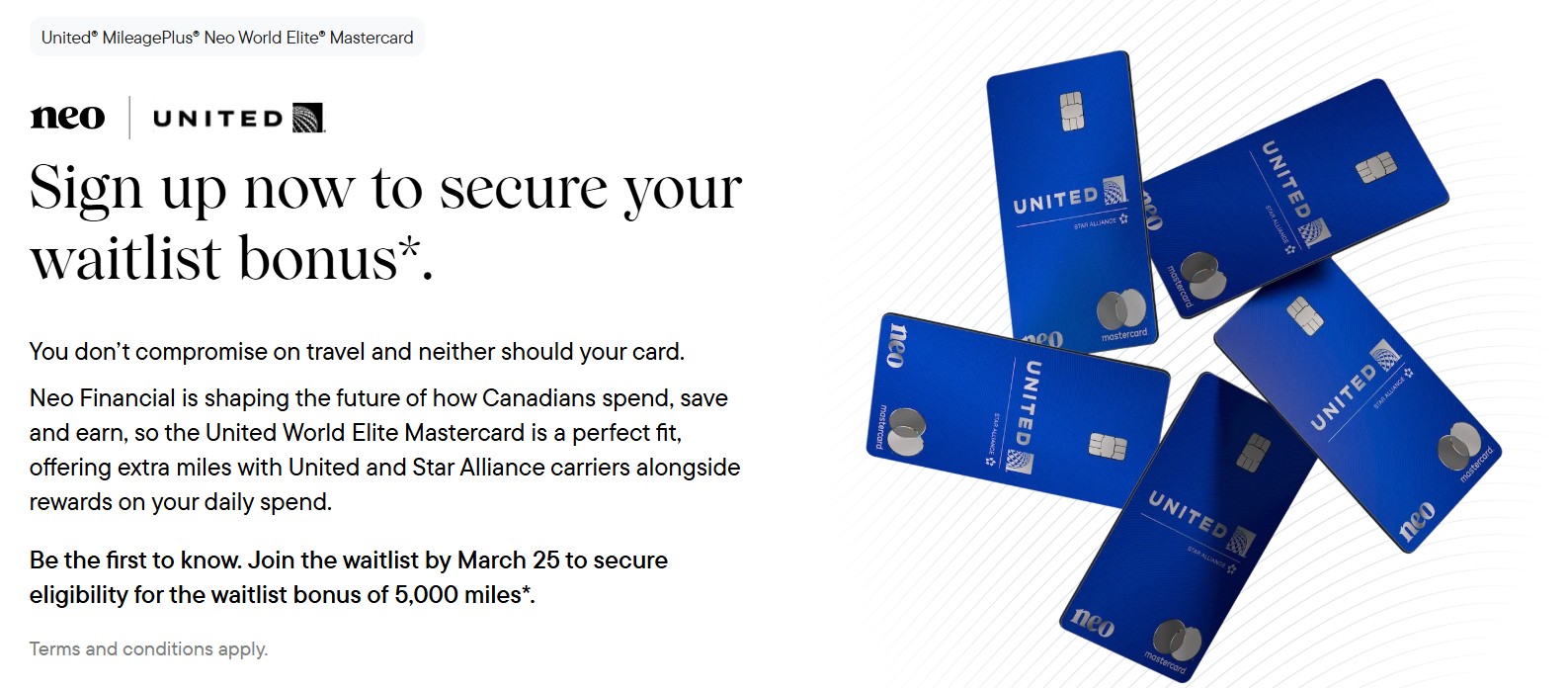
United Airlines is entering the Canadian credit card market with a new co-branded product: the United MileagePlus Neo World Elite Mastercard. The card is being issued by Neo Financial and is positioned as the first Canadian-issued credit card that earns United MileagePlus miles directly on everyday spending. Neo’s public waitlist page says the card will launch in April 2026, and the current waitlist runs from February 24 to March 25, 2026.
Canadian MileagePlus members have not previously had a local direct-earn option in the same way Aeroplan, WestJet Rewards, Avion, Scene+, and other programs have long been available through Canadian banks. Until now, Canadians wanting to build a MileagePlus balance typically had to rely on flying, hotel transfers, partner activity, or U.S.-issued cards that are generally not accessible without a U.S. credit profile. Based on what United and Neo have published so far, this launch changes that.
For Canadian travellers who regularly cross the border or redeem within Star Alliance, the significance is less about novelty and more about access. A direct-earn MileagePlus card gives Canadians another meaningful airline currency to consider alongside programs such as Aeroplan, Avion, and WestJet Rewards.
What has been confirmed so far
The official details released to date are still limited, but several core facts are already public. Neo’s waitlist page confirms the card name, issuer, and basic eligibility, including that applicants must be Canadian residents and meet the standard World Elite income threshold of $80,000 personal or $150,000 household income. The page also notes that a secured-card version is contemplated in the legal terms, which is unusual for a World Elite product in Canada.
Neo’s help centre also confirms that prospective cardholders need a MileagePlus number to join the waitlist, and that one can be created during the application process if needed. The waitlist bonus is 5,000 MileagePlus miles, but only for the first 3,000 people who join the waitlist, are approved, activate the card, and make a first purchase. Simply signing up does not lock in the bonus on its own.
What remains unconfirmed is just as important. Neo has not yet published the card’s annual fee, category earn rates, insurance package, foreign transaction fee policy, supplementary card pricing, or the full welcome offer. Its own help materials explicitly say those details will be shared closer to launch.
Why this launch matters for Canadians
The practical importance of this card is straightforward: it gives Canadians a domestic path to earn MileagePlus miles from regular spending. That is a notable addition in a market where most airline-focused credit card earning is concentrated around Air Canada and WestJet, plus transferable bank currencies like Membership Rewards, Avion, Aventura, and TD Rewards.
MileagePlus is worth paying attention to because United miles can be redeemed across Star Alliance, including Air Canada, Lufthansa, ANA, Singapore Airlines, and other partners. For travellers based in Toronto, Vancouver, Montreal, Calgary, or Ottawa, that opens the door to using one loyalty currency across a broad international network rather than only on a single airline. United also remains a major transborder and onward-connection carrier for Canadians heading to the U.S., Latin America, and beyond.
There is also a strategic angle. In the U.S., United has long used co-branded cards to deepen engagement with MileagePlus members. Launching a Canadian-issued card suggests United sees enough value in cross-border and partner traffic from Canada to support a local direct-earn product. For consumers, that means more competition in a segment that has historically been relatively concentrated.
The benefits we know about today
Although the full card package is still under wraps, early reporting based on the launch materials points to a few travel benefits that Canadian travellers should watch closely. Those include priority boarding on United flights, a free checked bag on United-operated flights, and accelerated MileagePlus earning with United and Star Alliance carriers. Reporting on the launch also says the card will connect with Neo’s merchant network for additional earning opportunities at participating businesses in Canada.
If those points hold when the card officially opens for applications, the product could appeal to two distinct groups. The first is the frequent or semi-frequent United customer who values day-of-travel perks such as boarding and baggage savings. The second is the points collector who wants a second airline currency in addition to Aeroplan, particularly for partner award flexibility.
The baggage benefit could be especially relevant for travellers who do not hold United elite status and often book standard economy fares on transborder routes. Even one free checked bag can offset a meaningful portion of an annual fee over a few trips, depending on how the final terms are structured. That said, until United and Neo publish the precise conditions, it is worth treating these benefits as promising but not fully defined.
How it may fit against existing Canadian cards
For most Canadians, the first question will not be whether this card is interesting. It will be whether it deserves a slot beside, or instead of, products they already carry.
If your main goal is Air Canada redemptions and domestic earning, a dedicated Amex Aeroplan Reserve or a Visa product such as the TD Aeroplan Visa Infinite still has the home-market advantage. Those cards are built around Air Canada benefits, easier integration for many Canadian travellers, and a far more established ecosystem.
If you prefer flexible points over one airline program, cards such as the Amex Cobalt or the RBC Avion Visa Infinite may still be more versatile for general spending. Flexible currencies can often be redirected based on availability, transfer bonuses, or fare prices, rather than locking you into one program. For readers comparing that route, our Avion guide and American Express Membership Rewards guide are useful reference points.
Where the new United card could carve out a niche is with Canadians who already credit flights to MileagePlus, regularly fly United through U.S. hubs, or want access to a local card that builds a United balance without relying on transfers. In other words, this is not likely to replace every points card in Canada, but it may finally give loyal United flyers a card designed for their actual travel habits.
A few caveats before Canadians rush to apply
The biggest caution is simple: there is still a lot we do not know yet. Without published earn rates, it is impossible to say whether the card will be competitive for groceries, dining, gas, travel, or non-category spend. Without the annual fee, it is also impossible to judge whether the benefits will justify the cost for occasional travellers.
The issuer also matters. Neo has grown quickly in Canada and has already powered other airline-affiliated cards, but some travellers may prefer to wait for full servicing, insurance, and cardholder-benefit details before applying. That is especially true for a travel card where claims handling, benefit administration, and purchase reliability matter as much as the earning side.
Finally, this product should be evaluated on Canadian realities, not U.S. expectations. American United cards often come with richer and more layered airline benefits because they are part of a mature domestic co-brand ecosystem. Canadian consumers should assess this new card on its own pricing, own earning structure, and own travel perks once the formal terms are released.
Who should pay attention to this card
This upcoming card looks most relevant for four groups of Canadian travellers.
1. Frequent United flyers
If you often fly United from cities like Toronto, Vancouver, Calgary, or Montreal into U.S. hubs, a co-branded card can make sense even before considering redemption value. Priority boarding and checked baggage benefits can reduce friction on routine trips, especially for travellers without status.
2. Star Alliance award collectors
Some travellers prefer to diversify beyond Aeroplan. Since MileagePlus miles can be redeemed across Star Alliance, this card could become a practical way to build a second pool of alliance miles through Canadian spending. That may be useful when partner award space prices better through MileagePlus than through Air Canada’s program.
3. Canadians who cannot access U.S. credit cards easily
A Canadian-issued product removes one of the biggest barriers to earning United miles directly. There is no need to establish a U.S. file just to hold a United-linked card.
4. Newcomers, if the secured option materializes as expected
Neo’s public legal language references secured cards in connection with this product. If that option launches in practice, it would be a rare path for newcomers or thin-file applicants to access an airline rewards card tied to a major global program. For now, though, the exact structure of that secured version has not been fully published.
What to watch before the April 2026 launch
The remaining details will determine whether this becomes a niche airline card or a genuinely competitive travel product in Canada.
The main items to watch are the annual fee, earn rates on United purchases and everyday categories, foreign transaction fees, insurance coverage, and whether the card includes any path to status-related benefits or annual spend rewards. If United and Neo can pair a reasonable fee with solid core earning and meaningful flight perks, the card could attract more than just existing MileagePlus loyalists.
It will also be worth seeing how this product handles partner redemptions and whether any Canadian-specific promotions appear at launch. Since the waitlist closes on March 25, 2026, interested travellers have only a short window to position themselves for the 5,000-mile waitlist offer.
Practical takeaway
The United MileagePlus Neo World Elite Mastercard is a notable launch because it gives Canadians something they have not had before: a locally issued credit card that directly earns United MileagePlus miles on everyday spending. The launch timing is currently set for April 2026, and the public waitlist is open until March 25, 2026, with a 5,000-mile bonus available to the first 3,000 eligible applicants who complete all required steps.
For now, the card is more important as a market development than as a finished recommendation. It clearly fills a gap for Canadian United flyers, but the final verdict will depend on pricing, earn rates, and the full benefits package once applications officially open.
For Canadian travellers, the most sensible approach is to view this as a card worth monitoring closely rather than pre-judging too early. If you already collect United miles or want another Star Alliance currency beyond Aeroplan, this is one of the more interesting credit card launches to watch this spring.