What is the Amex Fixed Points Travel Program?
The American Express Fixed Points Travel Program is a Canada-only Membership Rewards redemption option that lets you book an eligible return flight for a fixed number of points, up to a maximum base ticket price for that route category. It applies to flights booked through American Express Travel Services Canada or on americanexpress.ca/travel.
This is one of the most useful “middle ground” options in the Canadian points world because it sits between:
- simple fixed-value travel redemptions, and
- more advanced airline-transfer strategies like Aeroplan or Avios.
If you want a predictable, chart-like redemption without needing to search airline award inventory, this program can be very useful.
How Amex Fixed Points Travel works
The core idea is simple:
- Amex assigns a fixed number of Membership Rewards points to a route category.
- That fixed points amount covers the base ticket price only, up to a stated maximum base ticket price.
- Taxes, fees, and carrier surcharges are not covered by the fixed points amount.
- If your base fare is above the maximum allowed for the category, you pay the difference.
- If your base fare is below the cap, you still use the same fixed number of points, and the leftover value is not returned to you or applied elsewhere.
That last point is the most important thing to use as a guideline: Fixed Points Travel is strongest when your base fare is close to the maximum base ticket price for the category.
The Amex Fixed Points Travel chart
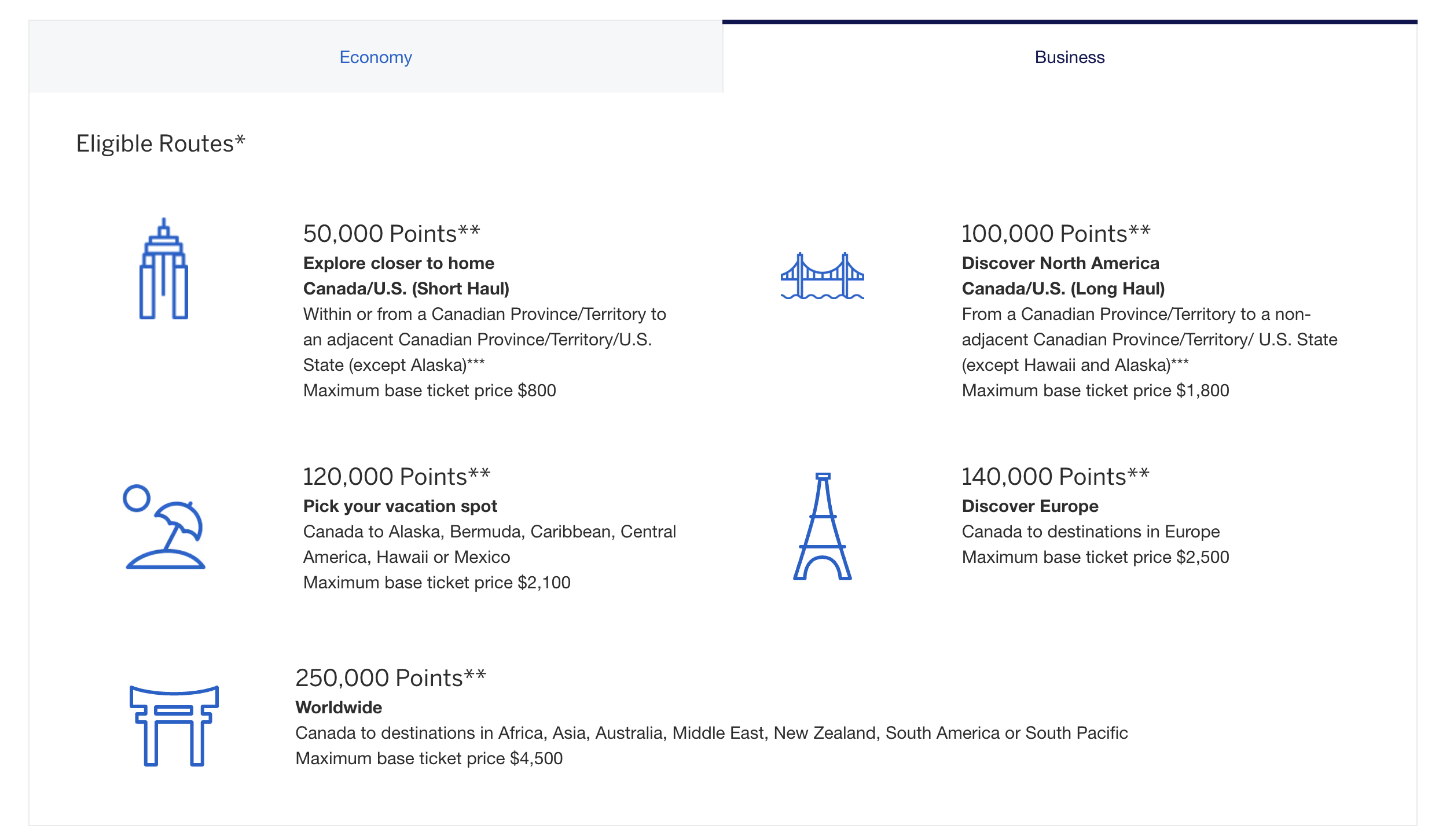
Amex Canada publishes separate Fixed Points Travel charts for eligible economy and business class return flights. The “Maximum base ticket price” is the most Amex will credit toward the base fare only, while taxes, fees, and carrier surcharges are extra. The CPP figures below show the maximum theoretical value at the cap.
Economy
| Category | Points | Maximum base ticket price | Cents per point at cap |
|---|---|---|---|
| Popular short-haul routes | 15,000 | $300 | 2.00 CPP |
| Canada / U.S. short haul | 20,000 | $300 | 1.50 CPP |
| Canada / U.S. long haul | 40,000 | $700 | 1.75 CPP |
| Canada to Alaska, Bermuda, Caribbean, Central America, Hawaii, or Mexico | 50,000 | $800 | 1.60 CPP |
| Canada to Europe | 60,000 | $900 | 1.50 CPP |
| Worldwide (Africa, Asia, Australia, Middle East, New Zealand, South America, or South Pacific) | 100,000 | $1,700 | 1.70 CPP |
Business
| Category | Points | Maximum base ticket price | Cents per point at cap |
|---|---|---|---|
| Canada / U.S. short haul | 50,000 | $800 | 1.60 CPP |
| Canada / U.S. long haul | 100,000 | $1,800 | 1.80 CPP |
| Canada to Alaska, Bermuda, Caribbean, Central America, Hawaii, or Mexico | 120,000 | $2,100 | 1.75 CPP |
| Canada to Europe | 140,000 | $2,500 | 1.79 CPP |
| Worldwide (Africa, Asia, Australia, Middle East, New Zealand, South America, or South Pacific) | 250,000 | $4,500 | 1.80 CPP |
Amex’s published “Popular Routes” examples for the 15,000-point economy band include Calgary–Vancouver, Montreal–New York, Toronto–Montreal, Toronto–New York, and Toronto–Ottawa. Amex also states that Fixed Points Travel applies to return airfares only, pricing is based on the highest class of service in the itinerary, and itineraries containing Premium Economy or First Class are not eligible.

Amex also highlights popular short-haul examples such as Calgary–Vancouver, Montreal–New York, Toronto–Montreal, Toronto–New York, and Toronto–Ottawa. The program applies to return airfares only so you can't use this to book one-way flights.
What counts as short haul vs long haul?
Amex defines short haul as travel:
- within a Canadian province or territory,
- from a Canadian province/territory to an adjacent Canadian province/territory or U.S. state,
- with a few explicit exceptions.
Amex also says the following are treated as short haul:
- travel between any of the four Atlantic provinces
- travel originating in Ontario and going to New York or Michigan.
That means this program can be particularly interesting for:
- eastern Canada short hops,
- certain Ontario–U.S. border routes,
- and higher-priced domestic or transborder return trips where the base fare is close to the cap.
Business class is possible too, but with an important catch
Amex presents both economy and business views for the program, and says the program can be used for either eligible economy or business class return airfare. However, Amex also states that the itinerary is priced based on the highest class of service within the itinerary, and itineraries containing Premium Economy and/or First Class are not eligible for the Fixed Points Travel Program.
The safest framing is:
- the program supports eligible return flights in economy or business class,
- but mixed-cabin itineraries with premium economy or first class break eligibility,
- and the highest cabin on the itinerary determines the pricing logic.
What Amex actually charges you at booking
When you book through Fixed Points Travel:
- The full cost of the flight is charged to your card at checkout.
- That includes the base fare, taxes, fees, and carrier surcharges.
- You redeem the fixed number of Membership Rewards points.
- Within about 5–10 business days, Amex applies a statement credit for the base ticket price, up to the applicable cap.
So this is not a traditional “pay with points instantly and only pay the remainder” airline-booking flow. It behaves more like:
- Amex charges the full airfare first,
- then credits back the eligible base fare amount afterward.
That also means your statement cut date matters. If your statement closes before the credit posts, you may need to pay that balance in the normal course and receive the credit afterward.
What if the base fare is below the cap?
This is one of the most common mistakes people make with Fixed Points Travel.
If your category allows:
- 20,000 points for up to $300 base fare,
and your actual base fare is only:
- $220 base fare,
you still spend the full 20,000 points. The extra unused portion:
- cannot be applied to taxes,
- cannot be refunded,
- cannot be banked for later,
- and cannot help cover changes or cancellations.
That’s why cheap flights are often a poor use of this program.
What if the base fare is above the cap?
If the base fare is above the maximum for the category, you can still use Fixed Points Travel, but you will pay the amount above the cap in cash on your card, along with the taxes, fees, and surcharges.
Example:
- A route falls in the Europe category
- The redemption requires 60,000 points
- The maximum base ticket price is $900
- Your flight has a $1,050 base fare plus taxes/fees
You would still redeem 60,000 points, but you would only get up to $900 of statement credit toward the base fare, and you would pay:
- the extra $150 base fare above the cap
- plus taxes, fees, and surcharges.
Practical rule of thumb
- Below ~1.0 CPP effective value: usually weak, especially versus simple statement-credit uses of MR
- Around 1.2–1.5 CPP: often solid
- Near the cap: this is where Fixed Points Travel gets interesting
When Fixed Points Travel is best
This program is strongest when all of these are true:
1) The base fare is near the cap
This is the single biggest factor. The closer the base ticket price is to the maximum allowed for the category, the better the redemption value.
2) Cash fares are high, but airline award options are poor
Sometimes Aeroplan, Avios, or Flying Blue just don’t have useful space on your dates. Fixed Points Travel lets you book an eligible airfare anyway.
3) You want predictability
This is one of the few Canadian travel redemptions that feels structured and predictable without needing a separate airline loyalty account.
4) You want to book almost any airline
Amex markets the program as letting you book any airline, fly anywhere, and travel any day, subject to the program rules and availability through Amex Travel.
When Fixed Points Travel is not the best option
1) The base fare is cheap
If the base ticket price is far below the cap, you’re probably wasting points.
2) Transfer partners offer much better value
If the same trip is bookable through Aeroplan, Avios, or Flying Blue at a strong rate, transfers often win. That’s especially true for premium cabins and partner sweet spots.
3) You dislike portal-style booking
Fixed Points Travel requires booking through the Amex travel channel, not directly with the airline.
Fixed Points Travel vs Flexible Points Travel
During the same booking flow, you can opt to use the Flexible Points Travel program, which isn't really a good return.
Fixed Points Travel
- fixed number of points
- covers base fare only
- has route categories and fare caps
- strongest when base fare is near the cap.
Flexible Points Travel
- lets you use points toward all or part of the travel purchase
- includes taxes, fees, and carrier surcharges
- currently redeems at 1,000 points = $10 travel credit.
That means:
- Fixed Points Travel is the optimization play
- Flexible Points Travel is the simplicity play (but not the best value)
Fixed Points Travel vs transferring Membership Rewards points
This is the bigger comparison that's worth doing when looking at how best to use your American Express MR points.
Fixed Points Travel is better when:
- you want certainty
- you don’t want to wait for airline transfer times
- you haven’t found good award availability
- your base fare is close to the Amex cap
Transfers are better when:
- you found strong award availability first
- the airline program gives better value
- you want premium-cabin sweet spots
- you want stopovers, alliance options, or other advanced airline-program features
In practice:
- Aeroplan, British Airways Avios, and Flying Blue are the transfer comparisons that matter most for Canadian travellers. Those are all current Amex Canada airline partners.
Which Amex Canada cards can use Fixed Points Travel?
Amex’s current Fixed Points Travel page lists a wide range of eligible Membership Rewards-enrolled cards, including:
- American Express Card
- American Express Gold Rewards Card
- The Platinum Card
- Centurion Card
- American Express Cobalt Card
- Choice Card
- American Express Corporate Card for Small Business
- American Express Business Gold Rewards Card
- American Express Business Edge Card
- The Business Platinum Card
- certain Corporate Green / Gold / Platinum cards.
For most consumer readers, the most relevant ones are:
- Amex Cobalt
- Amex Gold Rewards
- Amex Platinum
Want to compare the best Canadian Amex and travel rewards cards?
Compare Membership Rewards cards, Aeroplan cards, Avion, Scene+, Aventura, and more — filter by annual fee, earn rates, lounge access, and transfer-partner flexibility.
Common mistakes to avoid
Booking based on total fare instead of base fare
Fixed Points Travel is based on the base ticket price, not the total after taxes and surcharges. That’s the most important mistake to avoid.
Using the program on cheap flights
If the base fare is low, you’re usually not getting the best value.
Forgetting you need enough points for all travellers
Amex states that if you are booking multiple travellers on the same itinerary, you must have enough points to cover all travellers at the fixed-points amount in order for the option to be presented.
Assuming leftover cap value applies elsewhere
It does not. Unused value below the cap is simply lost.
Quick decision checklist
-
Is the base fare close to the maximum allowed for the category?
- Yes → Fixed Points Travel may be a good deal
- No → compare Flexible Points Travel or transfer partners
-
Do you want to avoid award-search complexity?
- Yes → Fixed Points Travel is worth checking
-
Are taxes, fees, and surcharges very high?
- Be careful — they’re not covered by the fixed points amount
-
Did you already find strong Aeroplan / Avios / Flying Blue space?
- Transfer partners may be better
Bottom line
The Amex Fixed Points Travel Program is one of the most useful complementary tools in the Canadian Membership Rewards ecosystem.
It is not the most glamorous redemption option, and it won’t beat transfer-partner sweet spots every time. But it does something very valuable:
- it makes flight redemptions predictable
- it lets you book through Amex Travel with a fixed points chart
- and it can produce strong value when the base fare is close to the category cap
For Canadian travellers who want something between “cash out your points” and “become an airline-award expert,” Fixed Points Travel is a very strong middle path.