Aeroplan Pricing Check: Every Air Canada YVR to Sapporo Flight We Found (Winter 2026–27)
Air Canada’s new nonstop Vancouver to Sapporo (YVR–CTS) route is one of the most exciting winter additions in years—especially for anyone planning a Japan ski trip to Hokkaido.
But with Aeroplan dynamic pricing on Air Canada flights, the real question is simple:
Is this route pricing “reasonable” on points, or are we seeing sky-high numbers right out of the gate?
So we checked Aeroplan for every currently available nonstop YVR–CTS and CTS–YVR flight in the initial winter schedule window and logged the points required across:
- Economy
- Premium economy
- Business class
The Aeroplan distance band for YVR–CTS (and what “typical” pricing looks like)
Vancouver (YVR) to Sapporo (CTS) is roughly 4,288 miles, which puts it in Aeroplan’s:
- Between North America and Pacific zones
- 0–5,000 mile distance band
For this distance band, Aeroplan effectively gives you two useful benchmarks:
- Partner award pricing (fixed)
- Economy: 35,000
- Business: 55,000
- First: 90,000
Premium economy isn’t generally relevant on most partners in the way it is on Air Canada, so most people use Economy/Business as the clean “fixed” reference point.
- Air Canada dynamic pricing (variable)
- Published “starting at” (minimum) pricing for Air Canada tends to begin at:
- Economy: 35,000
- Premium economy: 45,000
- Business: 55,000
In other words:
- If you’re seeing numbers close to the starting levels, that’s strong.
- If you’re far above them, you’ll want to sanity-check the cash price before burning points.
What we found (one-way Aeroplan prices)
Notes:
- Points below are shown in thousands (so 46.6 = 46,600 points).
- The cash portion shown is taxes/fees and applies to all cabins on that flight.
YVR to CTS (Vancouver → Sapporo)
| Date | Economy (pts) | Premium economy (pts) | Business (pts) | Taxes/fees |
|---|---|---|---|---|
| Thu Dec 17 | 71.3k | 96.8k | 184.1k | $61 |
| Sat Dec 19 | 66.7k | 152.7k | 241.4k | $61 |
| Mon Dec 21 | 63.4k | 96.8k | 184.1k | $61 |
| Thu Dec 24 | 63.4k | 89.9k | 184.1k | $61 |
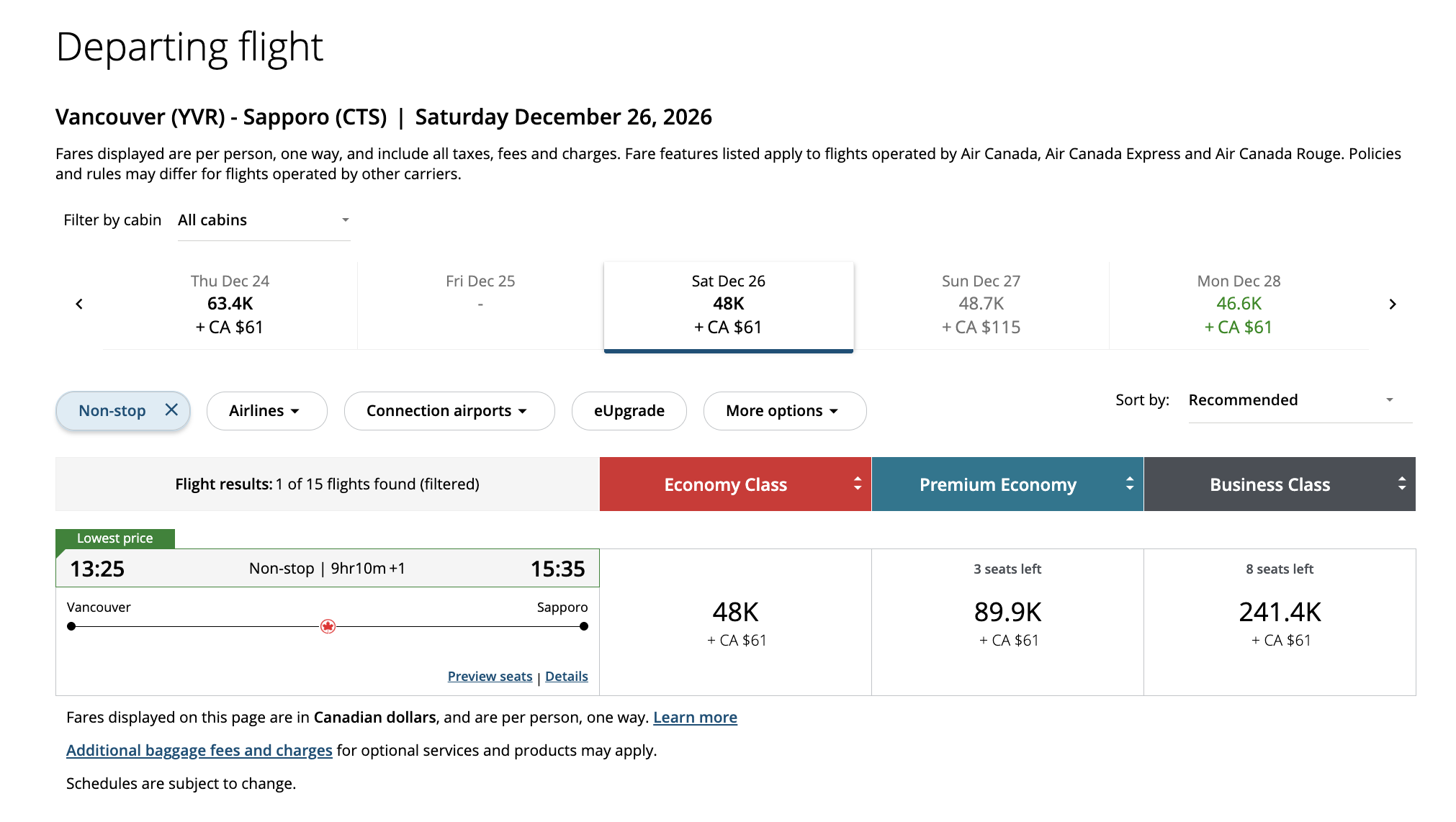
| Sat Dec 26 | 48.0k | 89.9k | 241.4k | $61 |
| Mon Dec 28 | 46.6k | 86.4k | 184.1k | $61 |
| Thu Dec 31 | 46.6k | 89.0k | 184.1k | $61 |
| Sat Jan 2 | 53.4k | 97.1k | 241.4k | $61 |
| Mon Jan 4 | 50.0k | 93.6k | 184.1k | $61 |
| Thu Jan 7 | 46.7k | 93.6k | 184.1k | $61 |
| Sat Jan 9 | 50.0k | 97.1k | 241.4k | $61 |
| Mon Jan 11 | 46.7k | 93.6k | 184.1k | $61 |
| Thu Jan 14 | 46.7k | 93.6k | 184.1k | $61 |
| Sat Jan 16 | 50.0k | 97.1k | 241.4k | $61 |
| Mon Jan 18 | 46.7k | 93.6k | 184.1k | $61 |
| Thu Jan 21 | 46.7k | 93.6k | 184.1k | $61 |
Quick range summary (YVR → CTS):
- Economy: 46.6k to 71.3k (+ $61)
- Premium economy: 86.4k to 152.7k (+ $61)
- Business: 184.1k to 241.4k (+ $61)
CTS to YVR (Sapporo → Vancouver)
| Date | Economy (pts) | Premium economy (pts) | Business (pts) | Taxes/fees |
|---|---|---|---|---|
| Fri Dec 18 | 71.3k | 109.2k | 195.7k | $32 |
| Sat Dec 20 | 78.0k | 109.8k | 255.3k | $32 |
| Tue Dec 22 | 71.3k | 108.3k | 195.7k | $32 |
| Fri Dec 25 | 71.3k | 108.3k | 195.7k | $32 |
| Sun Dec 27 | 94.8k | 131.8k | 255.3k | $32 |
| Tue Dec 29 | 86.4k | 119.1k | 195.7k | $32 |
| Fri Jan 1 | 73.8k | 108.3k | 195.7k | $32 |
| Sun Jan 3 | 78.0k | 109.8k | 255.3k | $32 |
| Tue Jan 5 | 71.3k | 108.3k | 195.7k | $32 |
| Fri Jan 8 | 71.3k | 108.3k | 195.7k | $32 |
| Sun Jan 10 | 78.0k | 109.8k | 255.3k | $32 |
| Tue Jan 12 | 71.3k | 108.3k | 195.7k | $32 |
| Fri Jan 15 | 71.3k | 108.3k | 195.7k | $32 |
| Sun Jan 17 | 78.0k | 109.8k | 255.3k | $32 |
| Tue Jan 19 | 71.3k | 108.3k | 195.7k | $32 |
Quick range summary (CTS → YVR):
- Economy: 71.3k to 94.8k (+ $32)
- Premium economy: 108.3k to 131.8k (+ $32)
- Business: 195.7k to 255.3k (+ $32)
Are these good redemptions (based on typical Aeroplan bands)?
Economy: mostly “okay,” but not amazing
For a 0–5,000 mile North America ↔ Pacific route, the mental anchor is:
- 35,000 starting level (and a fixed 35,000 if you ever find true partner pricing)
Here, the best economy prices we found are mid-to-high 40s (46.6k–46.7k) outbound, and low 70s inbound at best.
How I’d interpret that:
- 46–53k one-way is fairly reasonable for peak winter Japan travel, especially if cash fares are high.
- 70–95k one-way in economy is where you really want to compare cash pricing before redeeming.
Premium economy: often overpriced in points here
Premium economy starts “from” 45,000 in this band on Air Canada, but what we’re seeing is mostly:
- 86k to 153k one-way
That’s a wide spread, and many of these prices are high enough that premium economy can become a weak redemption unless:
- Cash premium economy fares are extremely high, and/or
- You highly value the comfort upgrade and would otherwise pay a meaningful premium out of pocket
Business class: very expensive compared to distance-based expectations
In this band, business class “starts” at 55,000, and your fixed partner reference point is also 55,000.
But the prices we found are:
- 184k to 241k (outbound)
- 195.7k to 255.3k (inbound)
That is far beyond what most people would call “good value” unless cash business fares are extremely high (or you’re redeeming for a special occasion where points cost matters less than the experience).
A simple way to judge value using cents per point
If you want a quick reality check, use this formula:
(value per point) = (cash fare − taxes/fees) ÷ points
Example (economy):
- If a one-way YVR–CTS cash fare is $1,200
- And the award is 46,700 points + $61
Then:
- ($1,200 − $61) ÷ 46,700 = about 2.44 cents per point
That would be a strong redemption.
But if the cash fare is $650:
- ($650 − $61) ÷ 46,700 = about 1.26 cents per point
- That’s more “meh,” and you might prefer saving points for a better use.
Best dates we found (if you’re trying to minimize points)
Lowest economy (YVR → CTS)
- 46.6k: Mon Dec 28, Thu Dec 31
- 46.7k: Thu Jan 7, Mon Jan 11, Thu Jan 14, Mon Jan 18, Thu Jan 21
Lowest economy (CTS → YVR)
- 71.3k shows up often (many Tue/Fri dates), but it doesn’t dip below that in our snapshot
Pattern worth noting
Outbound (YVR → CTS) has multiple “reasonable” economy dates in the high-40s. Inbound (CTS → YVR) is consistently pricier in economy, and can spike hard (94.8k on Sun Dec 27).
If you’re building a round trip, you may get better overall value by:
- Grabbing a lower-point outbound early
- Staying flexible on the return (or returning via another city if it materially improves total points)
Bottom line
Based on Aeroplan’s typical 0–5,000 mile pricing expectations:
- Economy awards on the best outbound dates (46k–53k) look decent, especially if cash fares are high for peak winter.
- Premium economy and business class are mostly priced at levels that will only make sense if the cash fares are extremely expensive (or if you’re prioritizing comfort above points efficiency). New to Aeroplan? Read our complete Aeroplan points guide to understand how the program works, including the Flight Reward Chart, Preferred Pricing, and stopovers.